Fleet enquiries for Africa[email protected]

Fuel Tanker Truck CLW

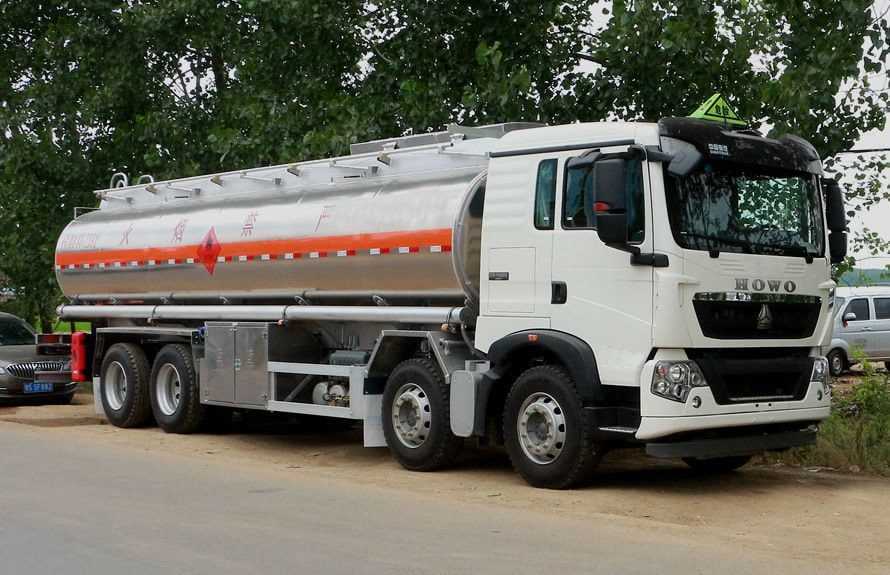
HOWO TX7 8×4 25–30 CBM Fuel Tanker Truck for African Bulk Trunk Haulage

The CLW HOWO TX7 8×4 is a 32-ton GVW rigid fuel tanker truck with a 350 HP diesel engine and 25–30 CBM capacity for bulk petroleum transport across Africa. Combining European-standard bottom loading, 12R22.5 18PR tires, and four-axle load distribution, it serves port-to-depot corridors, mine fuel farms, and industrial bulk users.

01 / Capability

Understand what the specification means.

25.5–29.5 CBM Effective Tank Capacity

25.5–29.5 CBM on 32,000 kg GVW 8×4 chassis

Delivers up to roughly 24,000 L of diesel or 27,000+ L of lighter petrol in a single rigid dispatch, slashing per-liter freight cost compared with medium 4×2 tankers.

Operating conditions
Assumes axle loads remain within destination four-axle legal limits (typically 30–32 t GVW) using balanced compartment filling.
What affects the result
Carbon steel vs. aluminum alloy tank mass, fuel density, number of internal bulkheads, and corridor weighbridge rules.

350 HP MC07H + 8-Speed Powertrain

350 HP (7.36 L) with HW11708STCL 8-speed

Provides strong low-end torque for loaded highway ascents and heavy-duty regional haulage while maintaining widely stocked HOWO service parts across Africa.

Operating conditions
Assumes scheduled fuel filtration and oil service matched to local diesel sulfur content.
What affects the result
Corridor elevation, ambient temperature, Euro emission configuration, and gross loaded mass.

8×4 Rigid Maneuverability & Bottom Loading

11,960 mm length; European bottom loading + 80/60 pump

Enters tight inland fuel farms and retail hub forecourts more easily than 16 m semi-trailers while maintaining fast bottom-loaded gantry turnarounds.

Operating conditions
Requires terminal gantry coupler compatibility and firm graded approaches suited to an 8×4 rigid wheelbase.
What affects the result
Yard turning radius, number of unloading compartments, hose length, and receiving tank backpressure.

02 / Specification

The vehicle, system by system.

The CLW HOWO TX7 8×4 25–30 CBM fuel tank truck delivers semi-trailer-class bulk volume in a self-contained rigid chassis that navigates depots, mines, and provincial road networks where articulated tankers face turning or length restrictions. Rated at 32,000 kg GVW with an 11,450 kg curb weight and 25.5–29.5 CBM effective tank volume, it is purpose-built for African petroleum haulers running port-to-depot trunk lines and bulk industrial supply.

Heavy-Duty 8×4 Chassis and 6 mm Tank Construction

Driven by the 7.36 L MC07H.35-60 350 HP diesel engine and HW11708STCL 8-speed manual transmission, the HOWO TX7 balances strong pulling power with straightforward mechanical maintenance. Its four-axle 1,800 + 4,575 + 1,400 mm wheelbase spreads heavy fuel loads across twin steer axles and twin rear drive axles fitted with 12R22.5 18PR radial tires and leaf-plus-air suspension. The 6 mm thick tank can be fabricated in carbon steel, lightweight aluminum alloy, or stainless steel for gasoline, diesel, and refined petroleum products.

Bulk Transfer Efficiency and Fleet Procurement

  • High-Throughput Gantry Operations: Fitted with a European-standard bottom loading system and 80/60 special fuel pump for fast turnaround at coastal import terminals and inland tank farms.
  • Rigid Multi-Axle Advantage: Easier reversing and yard positioning at mining fuel farms, power plants, and regional depots than 16 m articulated tankers.
  • Volume Fleet Rollout: Supplied from 1 unit upward with tiered FOB pricing—larger multi-truck fleet orders earn lower per-unit pricing and support phased batch delivery aligned with vessel space and contract start dates.

Chassis & powertrain
Chassis Model
HOWO TX7 8×4 Heavy Rigid Chassis
Engine Model
Sinotruk MC07H.35-60, 350 HP, 7.36 L Diesel
Transmission
Sinotruk HW11708STCL 8-Speed Manual
Emission Standard
Euro 2 / 3 / 4 / 5 / 6
Wheelbase
1,800 + 4,575 + 1,400 mm
Overall Dimensions (L×W×H)
11,960 × 2,500 × 3,550 mm
Suspension
Leaf Springs + Rear Air Suspension
Tires
12R22.5 18PR Radial
Body & tank
Suggested Tank Volume
25–30 CBM (25,000–30,000 L)
Effective Tank Volume
25.5–29.5 CBM
Tank Plate Thickness
6 mm
Tank Material Options
Carbon Steel / Aluminum Alloy / Stainless Steel
Allowed Transport Media
Gasoline, Diesel, and Petroleum Products
Working equipment
Fuel Transfer Pump
80/60 special fuel pump
Loading Architecture
European-standard bottom loading system
Power Take-Off
HW11708STCL gearbox PTO pump drive
Operating performance
Gross Vehicle Weight (GVW)
32,000 kg
Curb Weight
11,450 kg
Maximum Road Speed
80 km/h
Safety equipment
Four-Axle Load Distribution
8×4 twin-steer, tandem-drive chassis with leaf-plus-air suspension
Heavy-Ply Tire Spec
12R22.5 18PR radial tires rated for heavy highway loads
Bottom Loading Safety
European-standard bottom loading valve architecture and 80 km/h speed limit
Configuration options
Multi-Compartment Baffles
3–5 independent compartments for split petrol/diesel depot drops
Lightweight Alloy Tank
Aluminum alloy or stainless steel shell to reduce curb weight
Vapor & Overfill Package
Bottom-loading vapor recovery adapter and optical overfill sensors
Export Steering & Cab
LHD or RHD cab with sleeper berth and tropicalized AC
Metering & Safety Kit
High-flow bulk meter, grounding reel, and custom corporate livery

03 / Applications

Choose for the work ahead.

Suitable duties

  • Port-to-inland regional petroleum corridors requiring 25,000–30,000 L per rigid dispatch
  • Mining site bulk fuel storage replenishment over paved trunk highways and well-graded access roads
  • Oil marketing companies upgrading from 4×2/6×4 fleets where 16 m semi-trailers cannot turn inside depots
  • Multi-grade retail hub deliveries when partitioned into 3–5 bottom-loaded compartments
  • Fleets already operating Sinotruk HOWO trucks and leveraging shared regional spares

Outside the intended duty

  • Narrow urban side-street filling stations where an 11.96 m four-axle chassis cannot safely enter or exit
  • Extreme off-road ungraded tracks or deep mud pits where rear air suspension and 8×4 traction are unsuitable
  • Low-volume rural routes where a 25–30 CBM tank frequently runs half-empty
  • Corridors enforcing rigid four-axle weight caps well below 30 tons without reducing filled volume

04 / Procurement

A clearer brief. A better fleet fit.

  • Target compartment count (e.g., 3, 4, or 5 compartments) and fuel mix (diesel, petrol, Jet-A1)
  • Preferred tank material (6 mm carbon steel vs. lightweight aluminum alloy)
  • Destination country, port of discharge, steering side (LHD/RHD), and Euro emission standard
  • Regional four-axle legal GVW and bridge-formula limits on target haul routes
  • Required bottom-loading valve standard, vapor recovery, and flow-meter specification
  • Fleet order volume and phased batch shipment schedule
When does an 8×4 25–30 CBM rigid tanker make more sense than a fuel tanker semi-trailer?

An 11.96 m 8×4 rigid tanker is far easier to reverse and maneuver inside urban hubs, mining camps, and provincial stations with restricted turning aprons, while still hauling 25.5–29.5 CBM effective volume without tractor-trailer fifth-wheel maintenance.

Can we fill the full 30 CBM capacity with diesel on weighbridge-controlled highways?

Diesel weighs roughly 0.84 kg/L, so 30,000 L equals ~25.2 tons of cargo plus 11.45 tons curb weight (~36.6 tons total). On strict 32-ton GVW corridors, operators typically haul ~24,000 L of diesel or ~27,000 L of lighter petrol, or opt for an aluminum-alloy tank to raise legal payload.

How many compartments can be built into the HOWO TX7 25–30 CBM tank?

The tank can be customized from a single bulk chamber up to 3–5 independent compartments, each with its own European-standard bottom-loading valve and internal anti-surge baffles for simultaneous petrol and diesel drops.

How are large fleet orders priced and shipped?

Orders start at 1 unit, with tiered FOB unit pricing that drops as order quantity increases. Multi-vehicle orders can be scheduled in phased production and vessel batches to match your depot launch and customs clearance capacity.

Buying guide

Plan the right specification.

Your fleet. Your requirements.

Let’s configure your next vehicle.

Share the duty, destination and quantity. Include the details below so CLW can prepare a configuration and quotation for your project.

[email protected] ↗