
Zengdu Automobile Industrial Park
Suizhou, HubeiA broad view of Chengli’s industrial campus, bringing factory buildings, internal roads and the headquarters area into one manufacturing setting.
Factory tour
Explore the industrial parks, assembly halls and specialist production lines behind CLW special purpose vehicles.
An inside look
Chengli’s manufacturing operations bring together commercial vehicles, specialist bodies, production equipment and finishing facilities. This tour follows that wider manufacturing network, then moves inside the workshops to show how different vehicle families have their own production environments.
01The manufacturing network
Chengli’s manufacturing footprint spans Suizhou, Wuhan and Xiangyang. Its industrial parks support a range of commercial vehicle, special purpose vehicle and equipment operations. Explore a selection of the group’s sites below.
A broad view of Chengli’s industrial campus, bringing factory buildings, internal roads and the headquarters area into one manufacturing setting.
The Dali industrial park forms part of Chengli’s manufacturing network, with extensive workshop buildings and supporting facilities.
Large production buildings, vehicle areas and access roads show the layout of the Yinhang manufacturing site.
The Xinfu site extends Chengli’s industrial footprint to Xiangyang, with dedicated factory buildings and supporting infrastructure.
02Inside the workshops
A water bowser, a refuse compactor and a fire engine each bring different bodywork and equipment requirements. Specialist production areas sit alongside the group’s commercial vehicle assembly operations.
Commercial vehicle assembly
Overhead handling cranes and defined assembly lanes run through the commercial vehicle hall. Trucks, chassis and component stations are arranged along the production area, giving a closer view of vehicle assembly at workshop scale.
For a fleet project, the chassis and the specialist body need to be considered together. Steering position, dimensions, axle configuration and the intended duty are useful starting points for that discussion.
Explore configuration for AfricaBody structures, components and dedicated work stations line the compactor workshop. For a collection fleet, discuss the loading method, body arrangement and the operating cycle required by your routes.
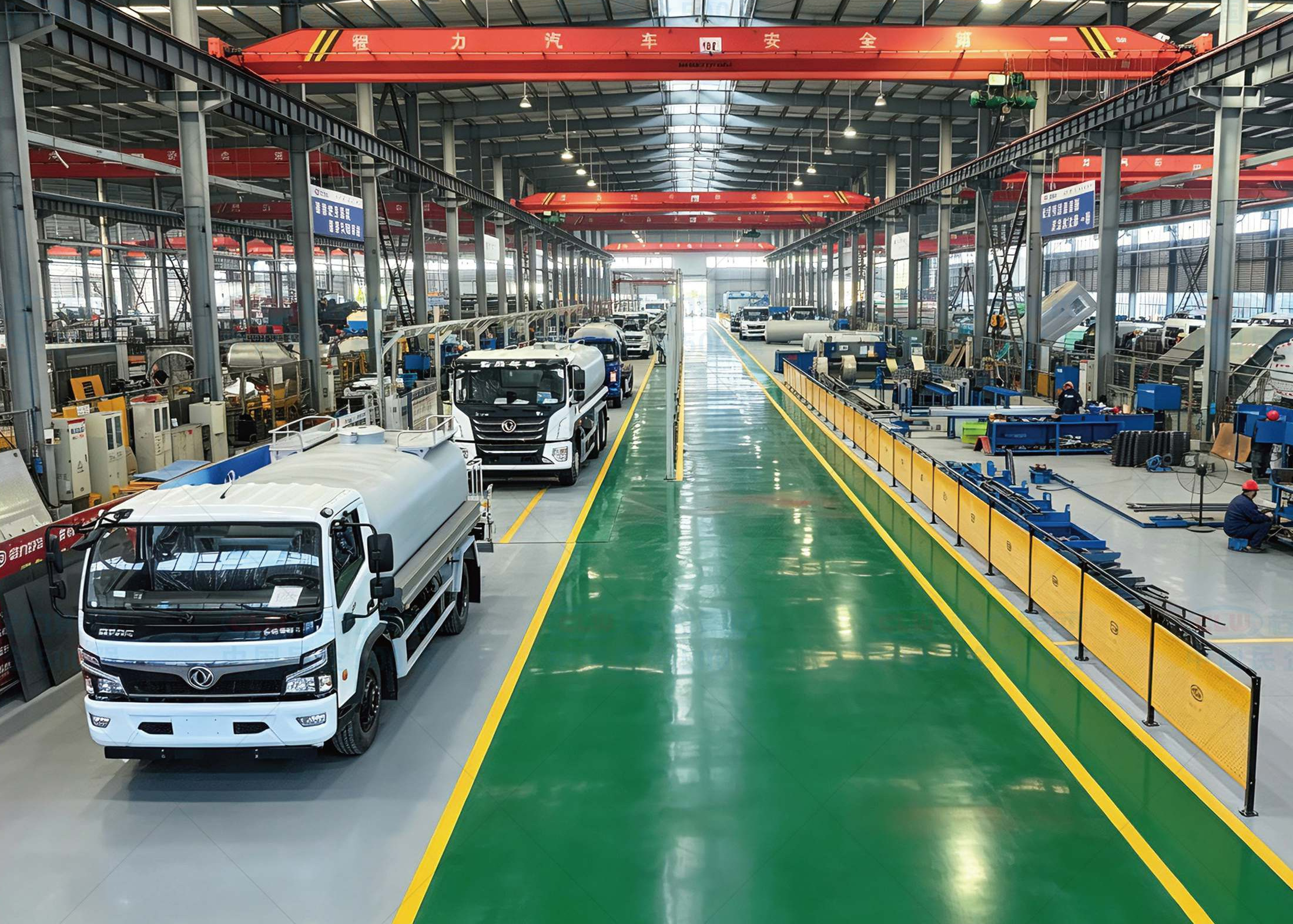
Explore the vehicle rangeTank shells and tanker bodies stand beside vehicles on the assembly floor. Discuss the intended liquid, tank capacity, material and discharge equipment as part of the complete vehicle specification.
Explore the vehicle rangeRows of fire vehicles and equipment stations occupy a dedicated workshop. A project discussion can cover the crew arrangement, water and foam requirements, equipment storage and the planned response role.
Explore the vehicle range03Beyond final assembly
Body production is supported by dedicated process areas. The coating and spraying facilities provide a closer look at the manufacturing environment behind the finished vehicle.
The electrophoretic coating line includes enclosed process equipment, handling systems and work areas for vehicle components. For your project, discuss which components are included in the agreed coating specification.
Separate booths, overhead lifting equipment and defined access lanes give the spray facility its own working layout. Discuss the agreed colour, paint system, finish and operating conditions alongside the body specification.
A wider production capability
The new energy workshop combines vehicle platforms with organised component storage and overhead handling equipment. Light commercial vehicles and vehicle components can be seen within the same production hall.
For a fleet considering a new energy vehicle, discuss the available chassis platform, charging requirements, operating routes and local service arrangements alongside the specialist body configuration.
04Make the tour relevant to your project
A useful visit starts with the work your vehicle needs to do. Share your project brief in advance so the discussion can focus on the vehicle family, configuration and production areas that matter to your fleet.
Tell us the destination country, vehicle application, quantity, target capacity and steering preference. Add your expected delivery timing and any tender requirements.
Use the visit to discuss the chassis, body layout, working equipment, access for maintenance and the controls your operators will use.
Set out the agreed configuration, operating demonstration, document package and any inspection arrangements in your purchase discussions.
Email the sales team with your proposed dates, vehicle type and project requirements. Agree the agenda and site access before making travel arrangements.
Tell us which vehicle family and configuration you are considering. Ask the sales team to plan the discussion around the relevant workshop and the current production schedule.
Start with the destination, application, chassis and steering position. Then discuss body capacity, working equipment, servicing, documentation and the checks to be completed before handover.