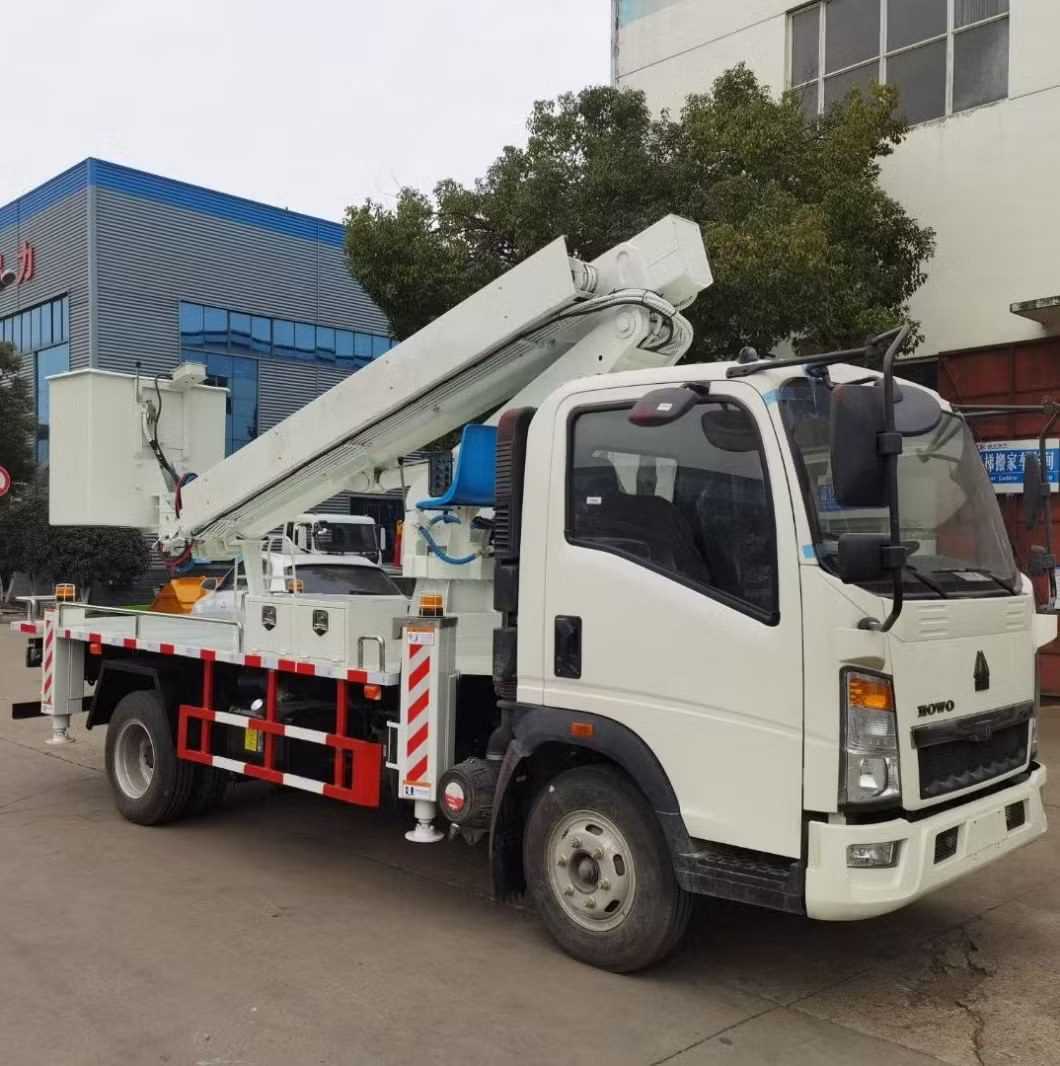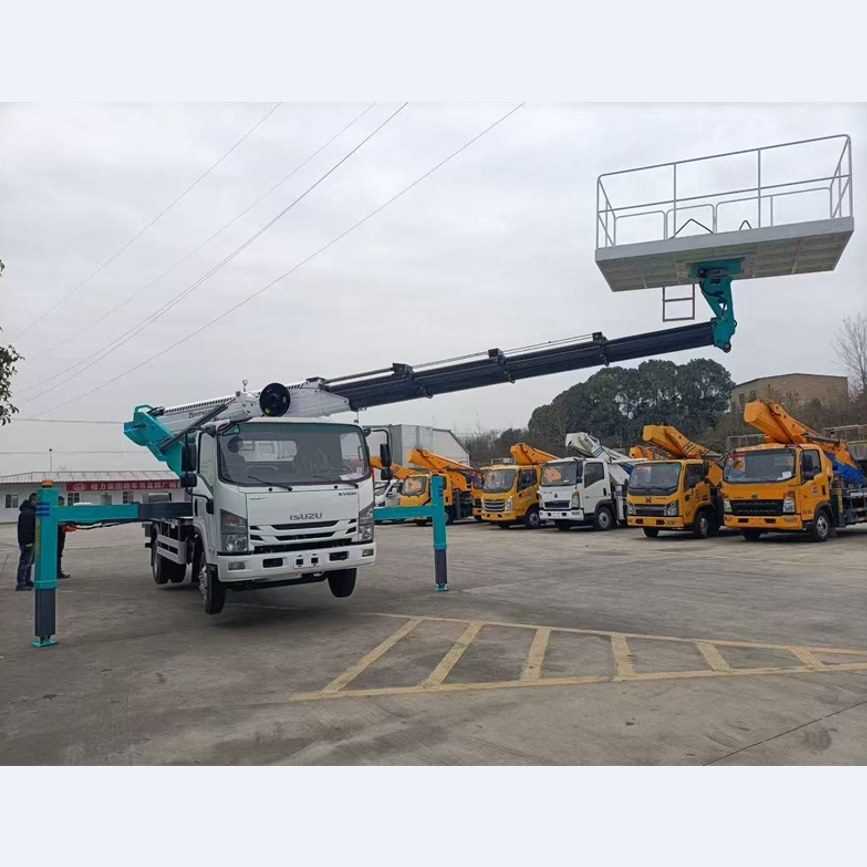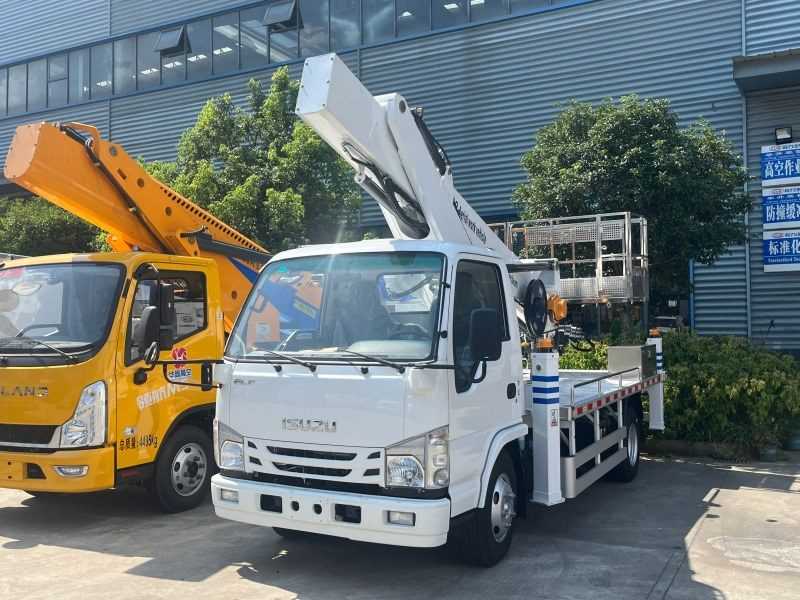
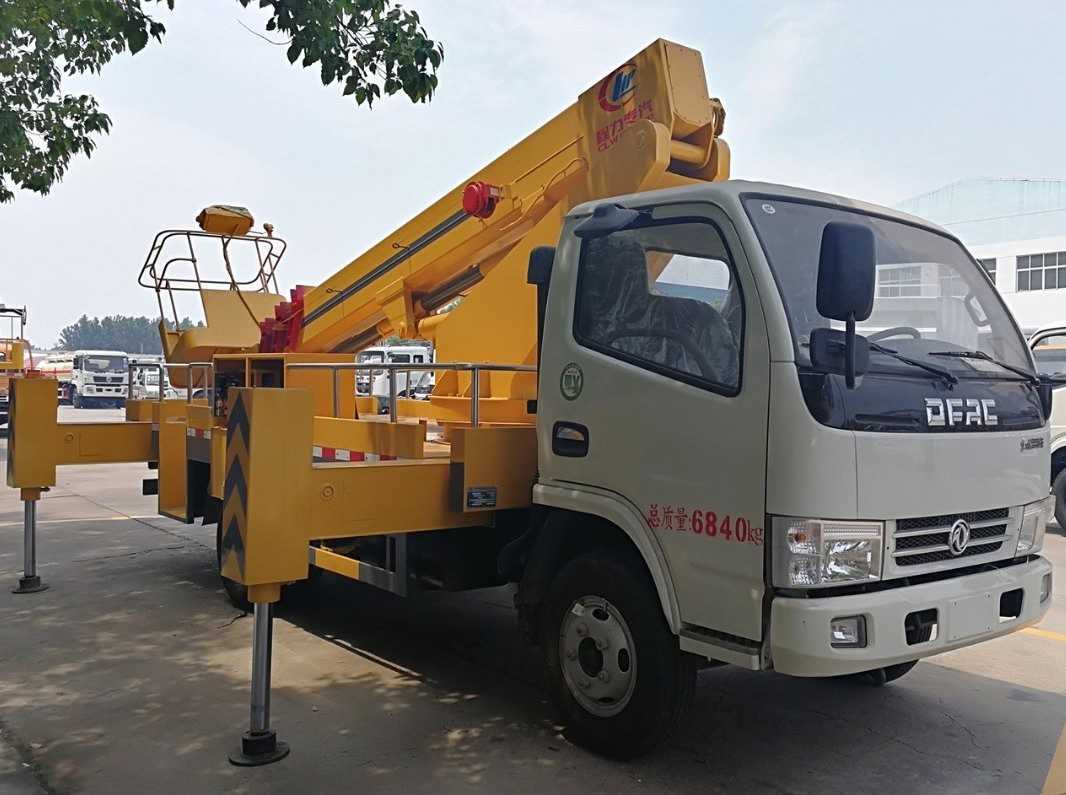
Across Africa, expanding streetlight corridors, power grid upgrades, telecom rollouts, and outdoor signage projects have made truck-mounted aerial work platform trucks indispensable fleet assets. Whether procurement teams in Nigeria, Kenya, Ghana, Zambia, Tanzania, Zimbabwe, or Uganda search for a cherry picker, a manlift, or an insulated bucket truck, the objective is identical: lift crews safely, clear faults fast, and move between work sites without support haulage.
Mismatched specifications drain budgets rapidly. A boom two metres too short pushes technicians back onto unsafe ladders, while an oversized 32-metre chassis burns unnecessary diesel on narrow residential streets. This buying guide covers truck-mounted reach selection, 14m–32m working heights, insulated fibreglass versus steel baskets, boom architecture, and realistic landed price drivers.
Cherry Picker vs Manlift vs Bucket Truck—Choosing Truck-Mounted Reach
Regional terminology varies across African buyers. Municipal and telecom contractors commonly use cherry picker and manlift for elevated platforms, while power utilities specify bucket truck for truck-mounted units fitted with personnel baskets for overhead line work.
Before comparing height ratings, fleet managers must weigh self-propelled yard lifts (scissor lifts and wheeled boom manlifts) against truck-mounted platforms. Scissor lifts belong inside flat concrete warehouses; on municipal roads and rural feeders, truck-mounted units dominate for four operational reasons:
- Rapid highway transit: Streetlight and utility crews routinely cover 30–120 km per shift. A truck-mounted cherry picker travels at 80–95 km/h between fault zones, eliminating the flatbed carrier, ramps, and loading delays required by self-propelled manlifts.
- Uneven shoulders and drains: Poles and lamp columns frequently sit behind open storm drains or soft laterite verges. Self-propelled lifts lock out on minor slopes, whereas H-type or V-type hydraulic outriggers level a truck chassis reliably on rough roadsides.
- Engine-driven PTO reliability: Battery manlifts suffer charging interruptions during grid outages and rapid battery wear in 42°C ambient heat. Truck-mounted hydraulics run off the diesel engine via a power take-off (PTO), delivering steady power anywhere fuel is available.
- Integrated crew and tool transport: Single or double-row cabs carry two to six technicians while lockable deck toolboxes store LED fittings, insulators, fuse cutouts, and traffic cones in one dispatch vehicle.
Chassis selection must also match local road law and fuel quality. West and Central African markets require left-hand drive cabs, while East and Southern African countries mandate right-hand drive units—see our LHD and RHD options guide. Matching engine specs to regional diesel sulfur levels through proven Euro II and Euro III chassis configurations prevents injector and after-treatment breakdowns on remote feeders.
Working Height Guide: 14m, 18m, 22m, 28m & 32m Applications
A common tender mistake is confusing working height with platform height. Working height equals maximum basket floor elevation plus 1.8m–2.0m of technician reach. An 18m working-height truck places the operator's feet around 16m—ideal for 12–14m streetlights or 11 kV cross-arms, but short for 20m high-mast floodlights.
Equally important is horizontal outreach. Roadside drainage trenches, parked minibuses, and soft verges rarely let trucks park directly beneath a pole. Always evaluate lateral outreach at full bucket load alongside vertical height.
| Working Height | Platform Height | Primary African Applications | Chassis Class | Key Operational Advantage |
|---|---|---|---|---|
| 14m – 16m | 12m – 14m | Municipal LED streetlights, estate lighting, CCTV poles, 400V drops | 4.5t light-duty 4x2 | Tight turning radius, low fuel burn, narrow lane access |
| 18m – 20m | 16m – 18m | Arterial roadways, 11 kV feeders, telecom micro-cells, tree pruning | 7t medium-light 4x2 / 4x4 | Stronger outrigger stance and extra tool payload |
| 22m – 24m | 20m – 22m | 11 kV / 33 kV lines, highway gantries, unipole billboards, facades | 8t – 10t medium-duty 4x2 / 4x4 | Wide H-outrigger span and deep horizontal outreach |
| 28m – 32m+ | 26m – 30m | Interchange high-masts, bridge soffits, port cranes, tall towers | 14t – 18t heavy 4x2 / 6x4 | Multi-stage telescopic reach with weighbridge axle balance |
Matching Chassis Duty Class to Terrain & Weighbridges
For urban streetlight contracts and dense estates in Accra, Kampala, or Dar es Salaam, 4.5-tonne light-duty builds such as the CLW Aerial Work Platform Truck · CLW5041JGKB6 and CLW Aerial Work Platform Truck · CLW5040JGKJDP navigate tight streets efficiently with low operating cost. When teams maintain arterial highways and carry heavier line hardware, stepping up to a 7-tonne class build like the CLW Aerial Work Platform Truck · CLW5070JGKADT adds valuable structural stiffness and deck payload.
For regional power utilities servicing 11 kV–33 kV corridors or billboard installers needing 22m–24m reach, a 10-tonne medium-duty platform like the CLW Aerial Work Platform Truck · CLW5100JGKCDT delivers the chassis weight and frame strength required for wide outrigger stability. Above 28m, operators crossing East and Southern African highway weighbridges must confirm stowed front and rear axle loads before ordering to avoid transit penalties.
Never evaluate a bucket truck on vertical height alone. Request the factory working-envelope chart showing horizontal outreach at full 200 kg bucket load. Confirming mid-elevation reach (typically 9m–12m on 22m units) guarantees your crew can clear roadside storm drains safely.
Insulated Fibreglass Bucket vs Steel Basket for Power Utility Work
Basket construction is a frontline safety decision. Municipal streetlight and signage contractors typically choose welded steel or aluminium-alloy baskets for impact durability against lamp brackets and branches. However, crews operating near energized 11 kV or 33 kV conductors require electrical isolation.
An insulated bucket truck replaces the conductive metal cage with a high-strength fibreglass-reinforced plastic (FRP) bucket—paired, when specified for live-line proximity work, with an insulated fibreglass upper boom section and non-conductive hydraulic hoses to shield linemen from accidental phase-to-ground contact.
| Specification | Steel / Aluminium Basket | Insulated Fibreglass (FRP) Bucket |
|---|---|---|
| Target Work | De-energized streetlights, billboards, bridges, telecom | 11 kV / 33 kV distribution lines, transformers, utility work |
| Rated Load | 200 kg standard (heavy options up to 250–300 kg) | 200 kg standard (two linemen plus insulated hot-sticks) |
| Durability | High scrape resistance against poles and steel structures | Strong composite shell; use inner liner and inspect for cracks |
| Testing & Care | Routine weld inspection, touch-up paint, pin greasing | Keep FRP clean/dry; run periodic dielectric voltage tests |
| Cost Impact | Baseline build cost | Higher cost depending on bucket-only vs insulated boom spec |
Mandatory Hydraulic & Safety Gear for African Operations
Every utility or municipal bucket truck should specify five essential hydraulic and safety protections:
- 200 kg bucket load with automatic levelling: Hydraulic or linkage auto-levelling keeps the basket floor horizontal at all boom angles, reducing operator fatigue.
- Bi-directional hydraulic locks and balance valves: Mounted directly on boom cylinders and outrigger jacks, these lock oil immediately if a hose bursts or PTO pressure drops, preventing uncontrolled descent.
- Upper and lower dual control stations: Basket controls deliver smooth positioning at height, while a lower turntable override lets ground crew retrieve an incapacitated operator immediately.
- Emergency descent pump: An independent 12V/24V electric auxiliary hydraulic pump (plus manual hand pump) lowers and stows the boom safely if the truck engine stalls mid-air.
- Outrigger interlock and tropical cooling: Interlock logic blocks boom elevation until outriggers are grounded and prevents outrigger retraction while elevated. For 40–48°C dust-heavy routes, specify sealed junction boxes, dust wiper seals, and an upgraded hydraulic oil cooler—see our tropical dust-proof design guide.
Mounting an FRP basket onto a bare steel boom provides localized basket isolation only; it does not certify the aerial device for live-line contact. Power utilities working near energized 11 kV or 33 kV lines must explicitly specify test voltage, insulated upper boom sections, non-conductive oil lines, and periodic dielectric testing in the procurement contract.
Articulated (Folding) Boom vs Telescopic Boom Reach Comparison
Boom kinematics directly affect job speed around urban obstacles and long-term workshop maintenance:
- Articulated (folding / knuckle) booms fold two or three hinged sections compactly over the cab. They excel at "up-and-over" access—lifting past roadside telecom wires, tree canopies, or compound walls—and keep stowed travel length compact for urban turns and Ro-Ro shipping.
- Telescopic (straight) booms extend nested high-tensile steel stages via internal cylinders and chains or wire ropes. They deliver faster straight-line elevation, deeper horizontal outreach across dual carriageways and bridges, and higher rigidity at 22m–32m+.
- Hybrid telescopic-with-jib booms add an articulating fly-jib behind the basket, combining long telescopic reach with precise final-metre positioning around congested utility cross-arms.
| Criterion | Articulated (Folding) Boom | Telescopic (Straight) Boom | Hybrid (Telescopic + Fly-Jib) |
|---|---|---|---|
| Height Range | 12m – 22m | 18m – 32m+ | 20m – 30m+ |
| Up-and-Over Agility | Excellent over trees, walls, parked vehicles | Limited to straight-line extension | Very good around cross-arms |
| Horizontal Outreach | Moderate at lower angles | Superior across wide carriageways | High reach plus precise basket placement |
| Workshop Care | More hinge pins, bushings, grease points | Fewer joints; monitor slide pads and chains | Combines telescopic pads and jib valves |
| Best African Fit | Dense urban streetlights and municipal estates | High-mast highways, billboards, bridges | Complex 11–33 kV utility distribution fleets |
For regional workshops with limited electronic diagnostics, straightforward manual or hydraulic-pilot multi-way valves using standard metric fittings and stocked seal kits generally achieve higher fleet uptime than proprietary electronic CAN-bus modules.
Bucket Truck Price Factors & Utility Tender Checklist
Comparing bucket truck price quotes requires unpacking the factory and landed-cost structure rather than focusing solely on nominal working height:
- Chassis and drivetrain (roughly 35%–45% of ex-factory price): Brand choice with strong African parts support (Dongfeng, ISUZU, Sinotruk HOWO, Foton, JAC), LHD vs RHD steering, 4x4 rural drivetrain, crew cab, and emission tier drive baseline chassis cost.
- Working height and boom steel (roughly 40%–50%): Price rises non-linearly with height. Stepping from 14m to 28m demands high-tensile boom steel, a heavier slewing ring, wider hydraulic outriggers, and a larger GVW chassis.
- Insulation and hydraulic upgrades: FRP insulated buckets, insulated upper booms, top-tier balance valves, proportional controls, 360-degree continuous rotation, 220V basket outlets, and 2-year wearing-parts kits raise upfront investment while protecting uptime.
- Ocean freight and destination clearance (FOB vs CIF): Landed price varies by Ro-Ro versus flat-rack shipping and port charges at Apapa/Tin Can Island, Tema, Mombasa, Dar es Salaam, Durban, or Beira. Compact stowed boom height lowers cubic-metre freight bills. Check our payment and African shipping guide and import compliance overview early to schedule PVoC, SONCAP, KEBS, TBS, or ZABS pre-shipment checks smoothly.
Note that factory management-system certifications on our certificates page verify manufacturing quality controls, whereas destination-country roadworthiness, dielectric tests, and conformity certificates are completed separately per national regulations. Final pricing always follows a written factory quotation aligned to your exact chassis, boom spec, steering side, and destination port.
Utility & Municipal Tender Checklist
Before evaluating bids, procurement committees should confirm seven essentials—supported by our utility tender support team and African delivery cases:
- Full working-envelope chart showing horizontal outreach at 200 kg basket load.
- Hydraulic schematic confirming bi-directional locks, emergency descent pump, and outrigger interlocks.
- Exact chassis sheet: LHD/RHD, engine model, emission level, wheelbase, and axle load split.
- Basket material and dielectric test documentation (if FRP insulated).
- Outrigger span, ground-bearing pressure, and supplied steel or polymer outrigger pads.
- English/French manuals plus a 2,000-hour spare-parts kit (seals, filters, solenoids, hoses).
- Pre-shipment factory inspection video covering full-load stability and 125% static overload testing—aligned with our buying workflow and official factory payment verification notice.
Frequently Asked Questions
What is the difference between working height and platform height?
Platform height is the elevation from ground to the bucket floor. Working height adds 1.8m–2.0m for operator reach. Always specify both target pole height and lateral setback across road drains when sizing a truck.
Do municipal streetlight contractors need an insulated bucket truck?
For strictly de-energized streetlight circuits, a steel or aluminium basket is durable and economical. Where lamps share poles with energized 11 kV feeders or utilities perform live-line work, an FRP insulated bucket and insulated boom package are essential.
Should African fleets buy a folding boom or a telescopic boom?
Choose an articulated (folding) boom for 14m–20m urban streets where crews must reach over trees, walls, and parked cars. Choose a telescopic or telescopic-jib boom for 22m–32m+ high-mast lights, wide highways, billboards, and bridges.
How long does production and shipping to African ports take?
Standard 14m–24m units typically take 25–45 working days for build, hydraulic calibration, and load testing; specialized insulated or 28m–32m builds take longer. Ocean transit adds roughly 25–45 days depending on East, Southern, or West African port routing and pre-shipment inspection.
Get a Factory-Direct Bucket Truck Quotation
Share five quick project details so our export engineers can send a matched working-envelope chart and CIF port quotation:
- Target working height (14m, 18m, 22m, 28m, or 32m+) and typical lateral setback.
- Application: de-energized streetlights/signage (steel basket) or power utility lines (FRP insulated bucket & voltage).
- Steering and drivetrain: LHD or RHD, 4x2 or 4x4, plus preferred chassis brand and emission tier.
- Preferred boom type (folding, telescopic, or hybrid) and options such as crew cab or 220V basket power.
- Destination African port (Apapa, Tema, Mombasa, Dar es Salaam, Durban, Beira), quantity, and tender timeline.